

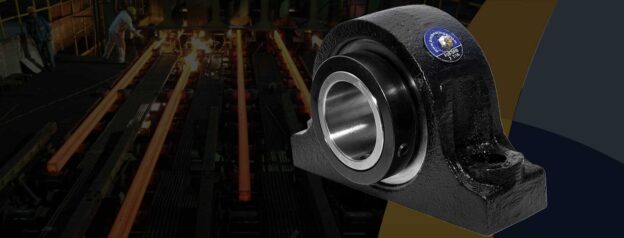
01 A HEFTY CHALLENGE: Tailor-made 4 row cylindrical bearings
An Italian customer recently challenged the BMI team’s strong engineering knowledge to develop a special 4 Row Cylindrical Roller Bearing for heavy machinery for steel plant application.
Weighing nearly 40 kgs with an outer diameter of 290mm, this bearing was one of the most challenging projects taken up by BMI. The BMI production team successfully executed the project within a short span of 12 weeks.
To deal with the heavy radial load application, the engineering team used Special steel 100CrSiMn6 for better results. The grading of cylindrical rollers was achieved within 3 microns for better accuracy. Given the satisfactory performance of the bearings customer has expressed interest in developing other large bore bearings for their machinery. Not only was BMI able to offer performance equivalent to European brands we were also able to offer faster delivery and smaller MOQ (Minimum Order Quantity).
Weighing nearly 40kgs with an outer diameter of 290mm, this bearing was one of BMI’s most challenging projects.
This customer breakthrough was very important for BMI to establish its name in the steel industry as this customer has a long standing reputation for building machines for steel plants for more than 50 years.
02 MAINTENANCE TIPS: Grease lubrication
Anti-friction bearings consist of some type of rolling element confined within an inner and outer ring.
In normal operating conditions, anti-friction bearings can be grease lubricated. The free space in the housing and bearing should only be partially filled with grease. 30% to 50% grease in the bearing housing is considered adequate.
Take care not to overfill the grease as this may cause a rapid rise in temperature, particularly at high speeds or it may prevent a bearing that is designed to float in its housing from operating properly. Bearings operating at slow speeds and those that require corrosion protection may have their housings completely full of grease. Additionally, over-filling.
If re-lubrication is not possible at frequent intervals due to operating conditions, it is sufficient to open the bearing housing to remove as much used grease as possible from the bearing. Then, repack fresh grease between all the rolling members from one side only.
Some provision is made for regreasing, usually in the form of a grease nipple fitted to the bearing housing if frequent re-lubrication is possible. A grease gun adds fresh grease to the bearing and replaces the old grease.
The lubrication duct in the housing should either feed the grease adjacent to the outer ring face, or, preferably, into the bearing by means of the lubrication groove. After numerous re-lubrications, the bearing housing should be opened and the used greased removed before fresh grease is added.